Cardan Shaft Coupling Purpose
In the intricate web of mechanical power transmission systems that underpin modern industrial and mobile machinery, the Cardan shaft coupling stands as a fundamental yet indispensable component, serving a spectrum of critical purposes that extend far beyond simple shaft connection. Often referred to as a universal joint coupling in practical engineering contexts, this device is engineered to address the inherent challenges of power transfer between non-collinear shafts, a scenario that arises frequently in nearly every sector where rotational motion drives operational functionality. Unlike rigid couplings that demand perfect shaft alignment and fail to accommodate even minor positional shifts, the Cardan shaft coupling is purpose-built to deliver reliable torque transmission while adapting to dynamic and static misalignments, making it a cornerstone of efficient, durable, and versatile mechanical design across countless applications.
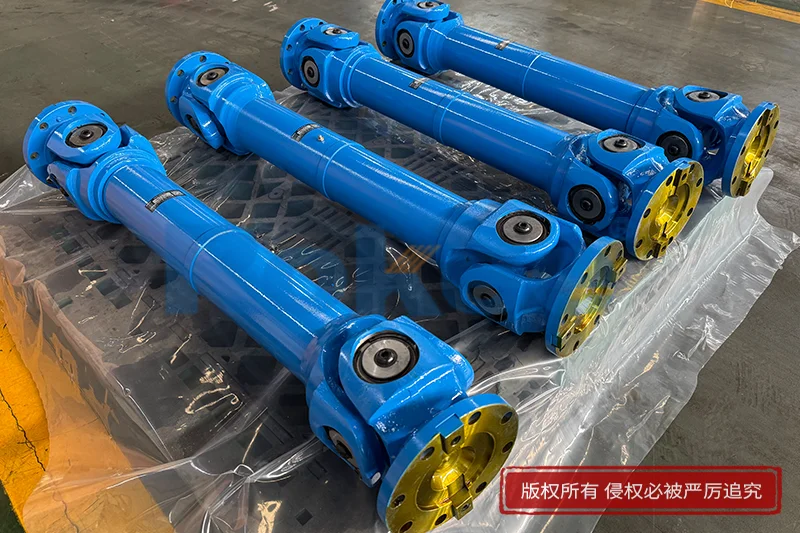
At its core, the primary purpose of a cardan shaft coupling is to facilitate the seamless transfer of rotational torque and motion between two shafts that do not share a common axis. In ideal mechanical setups, shafts would align perfectly along a straight line, eliminating the need for flexible coupling solutions, but real-world engineering environments are plagued by variables that disrupt this alignment. Manufacturing tolerances, assembly errors, thermal expansion and contraction during operation, structural deflection under load, and mechanical wear over time all create deviations between driving and driven shafts. The Cardan shaft coupling mitigates these issues by utilizing a articulated, cross-shaped joint design that allows for angular displacement between the connected shafts, typically ranging from a few degrees to more substantial angles depending on the specific configuration. This ability to transmit power at an angle ensures that rotational energy flows unimpeded from the power source—such as an engine, motor, or gearbox—to the end-use component, whether that is a wheel, a conveyor belt, a pump, or a manufacturing tool, without interrupting operational continuity.
Beyond angular misalignment compensation, the cardan shaft coupling also serves the vital purpose of accommodating axial and radial shaft movements, further enhancing its utility in complex mechanical systems. Axial displacement, which occurs when shafts shift along their longitudinal axis due to thermal growth or mechanical loading, is managed effectively by the coupling’s design, which can absorb minor to moderate linear shifts without imposing destructive stress on adjacent components. Radial misalignment, where shafts are offset parallel to one another rather than angled, is also addressed through the coupling’s flexible articulation, either independently or in combination with angular displacement in dual-plane misalignment scenarios. This multi-directional adaptability sets the Cardan shaft coupling apart from many other flexible coupling types, as it resolves a full range of alignment irregularities that would otherwise cause premature failure, excessive friction, and energy loss in power transmission chains. Without this adaptive capability, shafts would bind, bearings would wear out rapidly, and entire mechanical assemblies would suffer from reduced efficiency and shortened service life, driving up maintenance costs and operational downtime.
Another key purpose of the cardan shaft coupling is to preserve the mechanical integrity of connected equipment by reducing stress concentrations and dampening transient loads and vibrations. In high-speed or heavy-duty operating conditions, power transmission systems are subjected to sudden torque spikes, shock loads, and resonant vibrations that can propagate through shafts and damage delicate internal components—such as gears, bearings, and motor windings. The Cardan shaft coupling acts as a mechanical buffer, absorbing these shocks and vibrations through its articulated joint structure, preventing them from transferring fully between the driving and driven sides of the system. This damping effect not only protects critical machinery parts from impact damage but also minimizes noise generation during operation, creating a safer and more comfortable working environment for operators and reducing the risk of fatigue failure in structural components. Additionally, by distributing torque evenly across the joint and avoiding concentrated stress points, the coupling prevents shaft bending, cracking, and premature fatigue, even under sustained heavy loads or cyclic operating conditions.
The Cardan shaft coupling also plays a pivotal role in optimizing the overall efficiency of power transmission systems, a purpose that directly impacts operational performance and energy consumption. When shafts are misaligned, rigid connections create parasitic drag and frictional losses that convert useful rotational energy into heat, wasting power and reducing the output of the entire system. The Cardan shaft coupling’s ability to maintain smooth, continuous rotation despite misalignment eliminates these unnecessary energy losses, ensuring that a higher percentage of the input power reaches the intended load. This efficiency gain is particularly significant in applications where energy conservation is a priority, such as industrial manufacturing lines, heavy machinery, and automotive drivetrains, where even small reductions in energy waste can translate to substantial long-term cost savings. Furthermore, the coupling’s low-friction bearing design and robust construction minimize internal wear, preserving transmission efficiency over extended periods of use and reducing the need for frequent adjustments or replacements to maintain optimal performance.
Versatility across diverse operating environments and application types is a core purpose of the Cardan shaft coupling, making it a universally adopted component in both stationary and mobile machinery. In automotive and transportation sectors, these couplings are integral to drivetrain systems, connecting the transmission to the drive axles and accommodating the vertical movement of wheels over uneven terrain, as well as the angular shifts that occur during steering and suspension articulation. This adaptability ensures stable power delivery to the wheels, enabling smooth vehicle movement and handling even in challenging off-road or urban driving conditions. In agricultural machinery, such as tractors, harvesters, and tillers, Cardan shaft couplings transmit power from the engine to attached implements, adjusting to the variable angles and movements of farming equipment as it navigates rough fields and performs heavy-duty tasks like plowing, seeding, and harvesting. The coupling’s ability to withstand exposure to dust, moisture, and debris in outdoor agricultural settings further underscores its purpose of reliable operation in harsh conditions.
In industrial manufacturing and processing facilities, the cardan coupling serves as a vital link in conveyor systems, pumping stations, printing presses, metalworking machinery, and material handling equipment, where consistent power transmission is essential for uninterrupted production. Stationary industrial machinery often features long shaft runs or complex mechanical layouts that result in unavoidable misalignment, and the coupling’s ability to bridge these gaps ensures that production lines operate smoothly and consistently. For heavy industrial equipment, such as mining machinery, construction equipment, and marine propulsion systems, Cardan shaft couplings are engineered to handle extremely high torque loads and extreme operating conditions, from high temperatures and heavy vibration to exposure to water, oil, and industrial contaminants. Their rugged construction and adaptive design make them suitable for heavy-duty applications where failure is not an option, supporting continuous operation in demanding industrial environments.
The Cardan shaft coupling also fulfills a critical maintenance and serviceability purpose, simplifying the assembly, disassembly, and repair of mechanical systems. Unlike one-piece rigid connections that require precise alignment and complex installation procedures, the flexible, modular design of Cardan shaft couplings allows for easier mounting and removal, reducing the time and labor required for equipment setup and maintenance. When components within the power transmission system need replacement—such as bearings, seals, or shafts—the coupling can be disconnected quickly, minimizing downtime and streamlining repair workflows. Additionally, the coupling’s ability to compensate for minor alignment errors during reassembly reduces the risk of installation mistakes that could compromise system performance, making it a practical choice for maintenance teams working in fast-paced industrial or field settings. This serviceability focus ensures that machinery can be kept in optimal operating condition with minimal disruption to daily operations.
Beyond these functional purposes, the cardan joint coupling contributes to the overall design flexibility of mechanical systems, allowing engineers to create more compact, space-efficient, and ergonomic machinery layouts. In many applications, strict spatial constraints prevent the placement of power sources and driven components in a straight line, requiring angled or offset shaft configurations. The Cardan shaft coupling enables these non-linear designs by facilitating power transfer around obstacles, within tight enclosures, or across uneven structural layouts, eliminating the need for overly complex and costly transmission systems. This design freedom not only reduces the physical footprint of machinery but also improves accessibility for operation and maintenance, enhancing the practicality and usability of the equipment in real-world settings. Whether designing a compact industrial machine, a heavy-duty construction vehicle, or a specialized agricultural implement, engineers rely on the Cardan shaft coupling to achieve innovative, functional designs that meet operational needs without sacrificing performance or durability.
It is also important to recognize that the Cardan shaft coupling’s purpose evolves to meet the specific demands of specialized applications, with customized designs tailored to unique operating requirements. For high-speed rotational systems, precision-engineered Cardan couplings are built to minimize dynamic imbalance and vibration, ensuring stable performance at elevated RPMs. For low-speed, high-torque applications, heavy-duty couplings with reinforced joints and durable materials are employed to handle extreme load pressures without deformation or failure. In precision machinery, where tight tolerances and smooth motion are critical, finely tuned Cardan shaft couplings deliver consistent torque transfer with minimal backlash, supporting accurate positioning and operational precision. This adaptability to specialized needs reinforces the coupling’s role as a versatile solution that can be fine-tuned to serve the unique purpose of each mechanical system, regardless of industry or operational complexity.
In summary, the purpose of a cardan shaft coupling is multifaceted and deeply integrated into the reliable functioning of modern mechanical systems. It serves as the critical bridge for torque transmission between misaligned shafts, compensates for angular, axial, and radial positional deviations, protects equipment from shock loads and vibration, optimizes power transmission efficiency, ensures operational versatility across diverse environments, simplifies maintenance and assembly, and enables flexible, practical mechanical design. Without this essential component, the majority of industrial, automotive, agricultural, and marine machinery would struggle to operate efficiently, reliably, or safely, facing constant breakdowns, energy waste, and structural damage. The Cardan shaft coupling’s unassuming design belies its immense importance, as it quietly fulfills its core purposes to keep global machinery and production systems running smoothly, making it an irreplaceable element in the field of mechanical engineering and power transmission.
Tags: Cross Cardan Shafts , Industrial Cardan Shafts , Cardan Shafts , Cardan Shaft Couplings , sandwich panel machine , pu sandwich panel line
« Cardan Shaft Coupling Purpose » Update Date: 2026/7/15
Contact
If you require custom machined couplings, please contact Rokee via the contact information below for inquiries.
Email: https://www.gshmdpq.com
 WeChat
Industrial Couplings
You may also like
- Plate Couplings Engineering Drawing
- Tooth Couplings Working Principle
- Universal Coupling Joints Assembly Drawing
- Cardan Shaft Alignment Tolerances
- Tyre Coupling Gap Chart
- Working Principle of Bush Pin Type Flexible Coupling
- Universal Cross Joint Coupling Structural Diagram
- Universal Coupling Joint Uses
- Cross Cardan Shafts 3D Model
- Universal Joint Shaft Coupling Schematic Diagram