About the Researcher
Tong Lianming is Associate Dean of the School of Advanced Materials at Peking University Shenzhen Graduate School. He entered the College of Chemistry and Molecular Engineering at Peking University in 1998, began postdoctoral research in the Department of Applied Physics at Chalmers University of Technology in Sweden in 2007, and returned to China in 2011 as a recipient of the Institute of Physics, Chinese Academy of Sciences (CAS) institute-level Hundred Talents Program, where he focused on surface plasmons and surface-enhanced Raman spectroscopy. In 2015 he joined the College of Chemistry and Molecular Engineering at Peking University to work on spectroscopic characterization of nanomaterials. In 2024 he joined Peking University Shenzhen Graduate School full-time, where he is building an AI-enabled, full-chain intelligent R&D system for the design, preparation, characterization, and application of nanocarbon composite fibers.
Curiosity and Photons: Reading Each Molecule's Unique "Fingerprint" with Light
Every research journey begins with a simple childhood curiosity. Tong's story unfolds from an instinctive wonder about the colors of visible light—the very curiosity that first drew him to spectroscopy. Trained in physical chemistry as an undergraduate and graduate student, he was continually drawn to a central question in chemistry and materials science: how does structure determine properties? "Photons are an excellent external probe," he explains. "Through the interaction between photons and materials, we can characterize structure and properties quickly and at high throughput."
In his account, vibrational spectroscopy is essentially a system for identifying molecular "fingerprints": every molecule in the world has its own unique vibrational modes, and Raman and infrared spectroscopy capture the characteristic signals produced by these vibrations. These signals record the structural information within molecules—each material's own "identity fingerprint"—which is why vibrational spectroscopy is known as fingerprinting spectroscopy.
"The core question of spectroscopy has always been clear: what happens when a photon meets matter, and what clear physical picture of the material can we build from it?" A beam of probe light of a specific energy makes the microscopic, abstract molecular world observable and interpretable—a fascination that has kept him rooted in spectroscopic characterization for years.
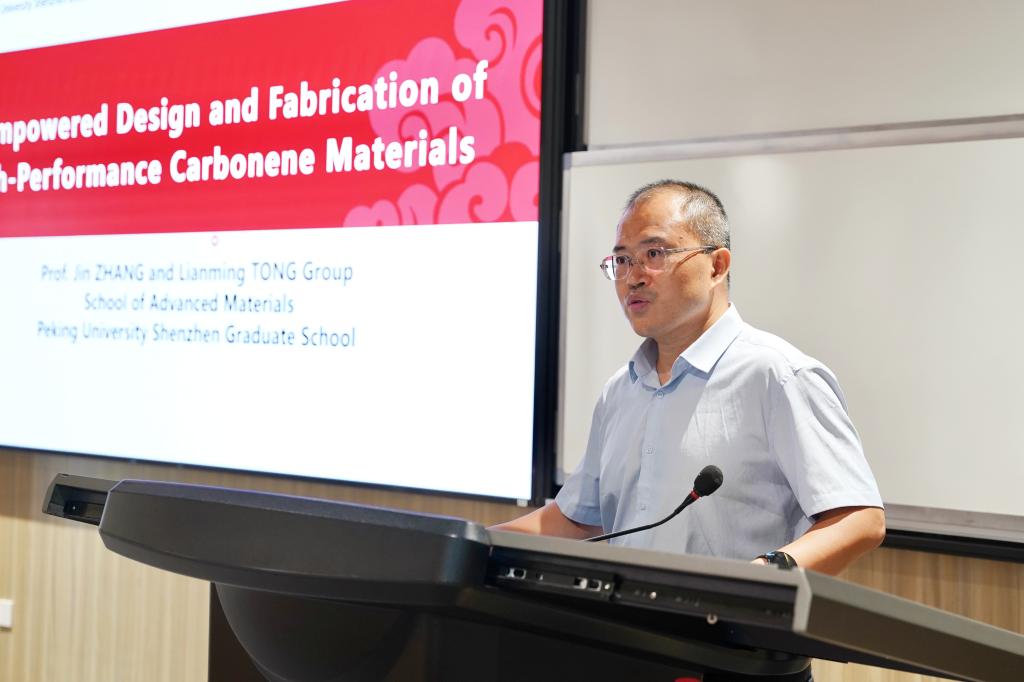
Tong Lianming in the classroom
A Leap and a Deep Dive: From Chemistry to Physics
In 2007, Tong made a pivotal decision: after completing his PhD, he went to the Department of Applied Physics at Chalmers University of Technology in Sweden for postdoctoral research—a leap from chemistry to physics, and from Beijing to Northern Europe. The choice was driven by two considerations.
On one hand, as his Raman spectroscopy research deepened, he realized that chemistry alone was insufficient to fully explain the underlying physical mechanisms of photon–molecule interactions; he needed solid grounding in physics. Chalmers' applied physics department, home to one of the world's leading surface-enhanced Raman spectroscopy groups at the time, offered a cutting-edge platform and academic perspective. On the other hand, Northern Europe's distinctive natural and cultural environment appealed to him after years in China, and he hoped to step outside his familiar academic surroundings and broaden his horizons.
During his four years in Sweden, he focused on surface plasmons and surface-enhanced Raman spectroscopy. What he gained was not only mastery of top-tier experimental techniques but also the ability to unpack chemical problems through physical thinking. "Stepping outside a single discipline is what sparks new research ideas—it's a necessary stage of growth for any researcher working at the frontier." This interdisciplinary perspective became the underlying logic of his two decades of research. After returning to China in 2011 to join the Institute of Physics, CAS, where he worked on nanophotonics, and moving in 2015 to Peking University's College of Chemistry and Molecular Engineering to study Raman spectroscopy of low-dimensional materials, he gradually clarified two distinct research paradigms in spectroscopy: one looking inward, investigating the fundamental principles and novel optical effects behind spectroscopic techniques; the other reaching outward, applying mature spectroscopic tools to solve practical problems in materials and industry. He shifted from a sole focus on fundamental spectroscopic mechanisms toward an integrated path of industry–academia–research collaboration—driven by the conviction that research should either advance fundamental knowledge or deliver practical application.
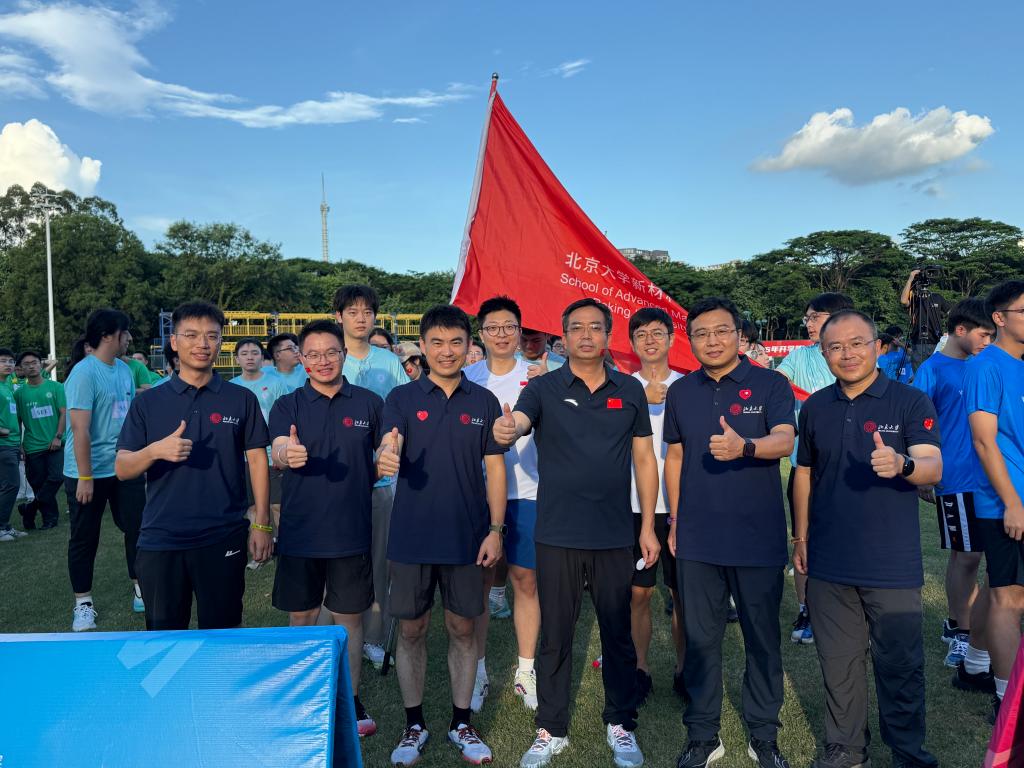
Tong Lianming (right) at a fun sports event
Breakthroughs and Empowerment: From Spectroscopy to AI-Driven Materials Research
In August 2024, Tong formally joined Peking University Shenzhen Graduate School, focusing on AI-driven nanocarbon materials research. Spectroscopic characterization plays a key role here—not merely in understanding how light interacts with materials, but in building high-throughput in-situ characterization techniques that, combined with AI, link material structure and performance online, making it a critical component of precise materials preparation and performance enhancement.
If spectroscopy is a "magnifying glass" for reading materials, AI is a new engine that multiplies R&D efficiency and reshapes research logic. Tong pursues three core stages of AI-enabled materials research, building a "data–model–experiment" closed-loop paradigm:
First, automated experimentation, overcoming the instability and inefficiency of manual operations. Traditional trial-and-error experiments rely heavily on manual work, and operator variability causes data fluctuations; automated full-process systems can run 24/7 with far greater stability and throughput.
Second, intelligent materials research. Building on high-quality data from automated experiments and shared literature and patent data, machine learning uncovers correlations and intelligently recommends the next optimization experiments.
Third, autonomous models for AI-enabled materials research. Building on large language models, high-quality automated experimental data, and data- and physics-driven models, AI-enabled materials research models should gradually acquire autonomous learning and self-evolution capabilities—shifting from "scientist's assistant" to "scientist's peer."
The team has already deployed this fully automated AI R&D pipeline in high-performance composite fiber development, boosting R&D efficiency hundreds of times over and achieving a breakthrough in the mechanical properties of aramid composite fibers that reaches internationally leading levels.
From Lab to Production Line: Letting Scientific Questions Grow from Real-World Scenarios
Arriving at the Shenzhen Graduate School, Tong was struck by the city's unique vitality: "Shenzhen stays green through all four seasons; the campus backs onto the Dasha River, with birds and small animals everywhere; at dawn the riverbanks and sports fields are full of young people exercising—the whole city is thriving." That vitality extends beyond the natural environment to Shenzhen's highly market-driven research ecosystem, where industry and academia are tightly integrated.
Unlike traditional universities that emphasize purely basic research, Shenzhen's industrial needs directly shape research directions, and Peking University Shenzhen Graduate School's well-developed commercialization mechanisms greatly streamline the management of research translation, opening a channel from lab to production line. Leveraging this platform, Tong and his team focus on nanocarbon composite polymer fibers and have established materials application collaborations with multiple enterprises. With his team, he also founded the Shenzhen-Hong Kong Hetao Science and Innovation Center (SHINES) and incubated Rhinovate™ Co., Ltd., dedicated to AI-enabled new materials R&D, working closely with leading new materials enterprises such as Wanhua and BTR.
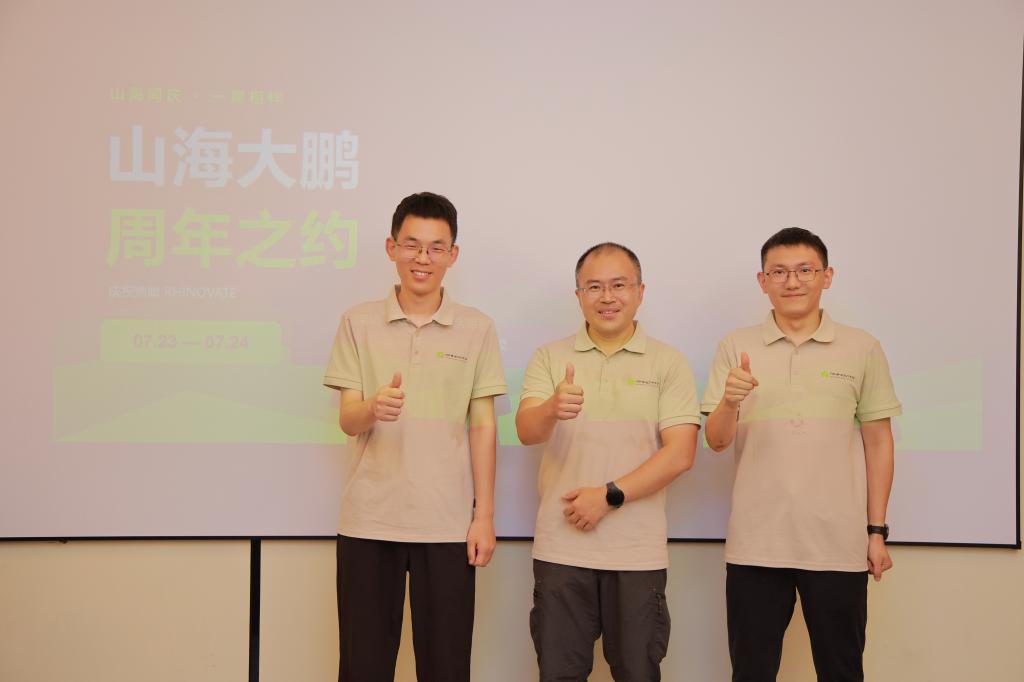
Tong (center) with his research team at Rhinovate™
Asked about the biggest challenge researchers face in commercialization, Tong is candid: a shift in mindset is needed. University scholars delve into basic science, but basic theory cannot stop at papers—it must take a step forward. If researchers design application scenarios purely from imagination, lab results easily become disconnected from companies' real needs. A truly sustainable industry–academia model should extract scientific questions from real industrial pain points—behind the process and engineering challenges raised by companies lie many fundamental mechanisms worth exploring. Research must actively engage with industry rather than building in isolation and then looking for applications.
Based on this philosophy, he has developed clear plans for student training. He places great emphasis on professional master's programs, believing that students' enterprise practice topics should align corporate needs with their advisors' research directions. "Through the professional master's training model, we promote research questions that come from real scenarios and build a bridge for translating research results from lab to enterprise; from the student development perspective, it broadens students' horizons and changes their ways of thinking, while also expanding their career options."
A "Mountain-Climbing" Message for Young People
Over the next three to five years, Tong has two clear goals.
First, to use the team's AI4M (AI for Materials) research paradigm to address engineering challenges in scaling materials from lab scale to ton-level mass production—helping solve the three pain points of production equipment setup, product stability, and production cost—and to launch commercially viable new materials truly oriented toward the market.
Second, to refine a standardized paradigm for AI-enabled new materials R&D, deeply connecting the mature R&D closed-loop model with materials enterprises to achieve large-scale industrial application of AI research tools.
To young faculty, students, and early-career researchers at Peking University Shenzhen Graduate School, Tong uses a mountain-climbing metaphor to share lessons from his years of cross-disciplinary study and transition into industrialization: "In whatever you do, direction always matters more than speed. To climb a mountain, you must at least know where the summit is—wandering aimlessly and steadily climbing toward a fixed point are two entirely different paths."
Everyone has a track they are suited to, he says—many simply haven't discovered it yet. Some are suited to deep basic research and high-level theoretical output; others are better at engaging with enterprises and driving technology transfer. Neither is superior. Young people should keep thinking and continuously adjust and calibrate their direction; only through sustained reflection and finding the right track can they firmly seize opportunities when they arise.
From a childhood curiosity about color to physical pictures in the lab; from the frontiers of nanophotonics at the Institute of Physics to materials characterization at Peking University's College of Chemistry; from the vibrant daily life along the Dasha River in Shenzhen to industrialization exploration at Rhinovate™—Tong's research path has always sought balance between "seeing" and "applying." Spectroscopy is both his tool and his metaphor: finding, amid the myriad signals, the frequency that belongs to his own direction. From basic science to industrial application, from spectroscopic characterization to AI-driven materials research, he is drawing on more than two decades of technical depth to answer the childhood question about the colors of a rainbow.